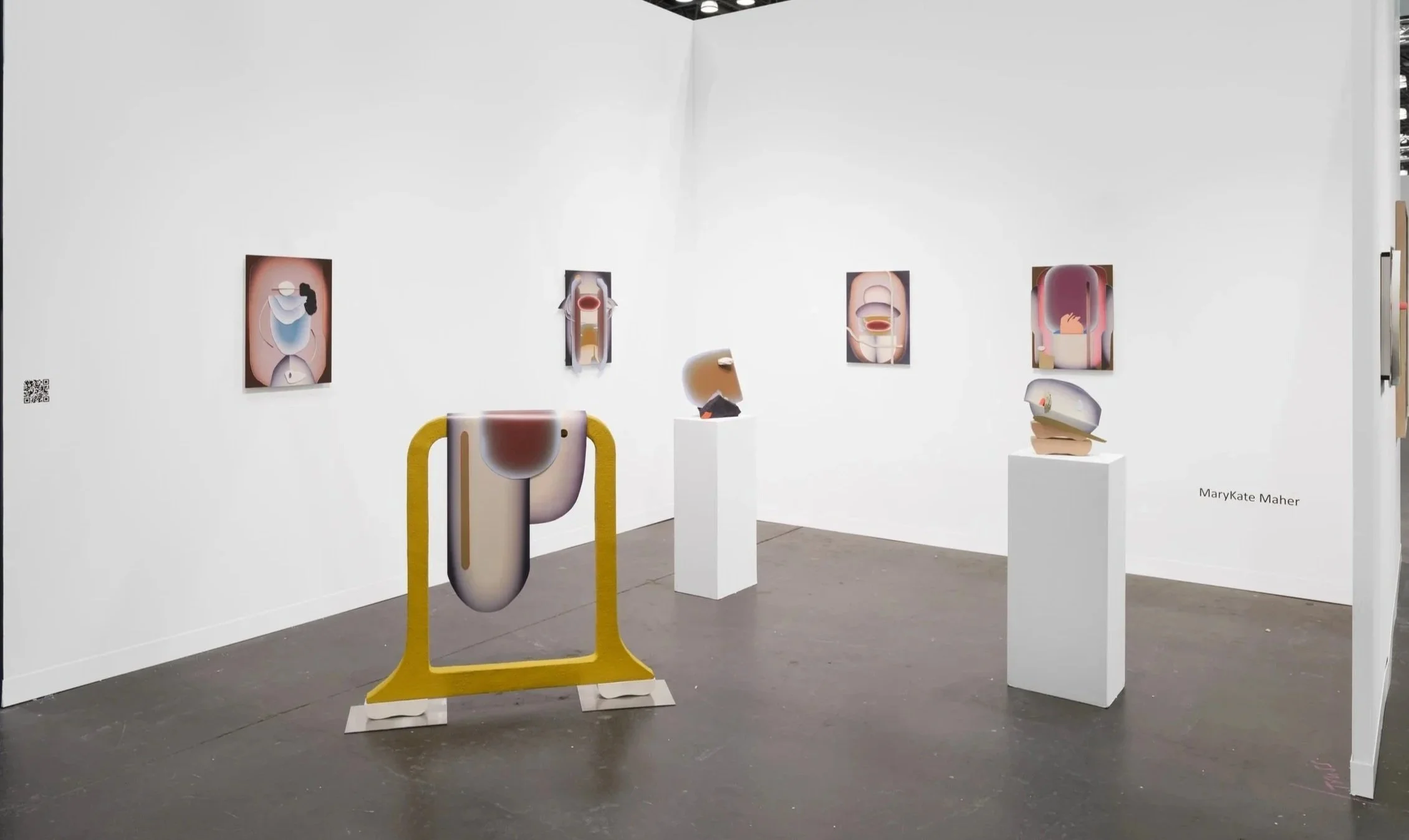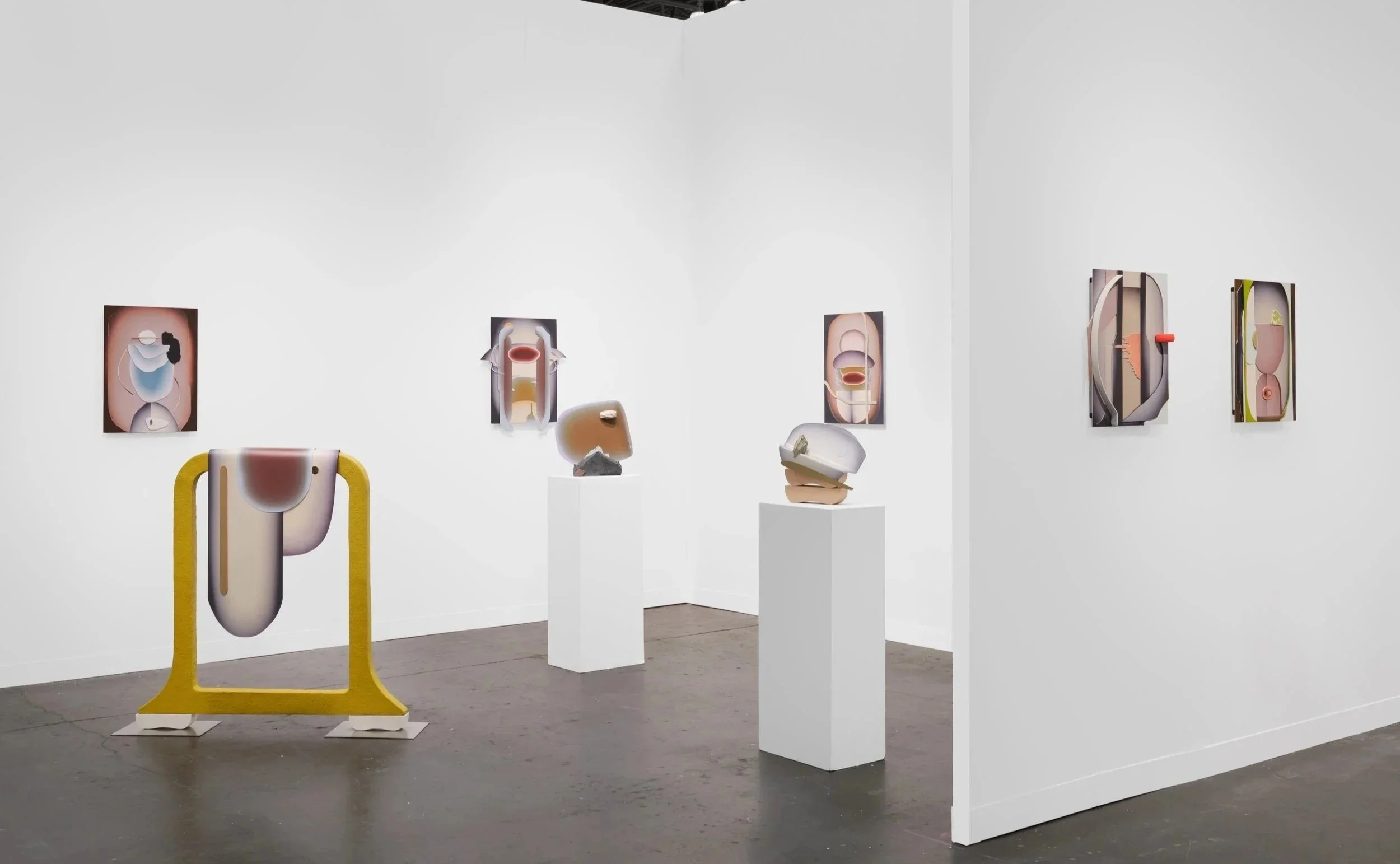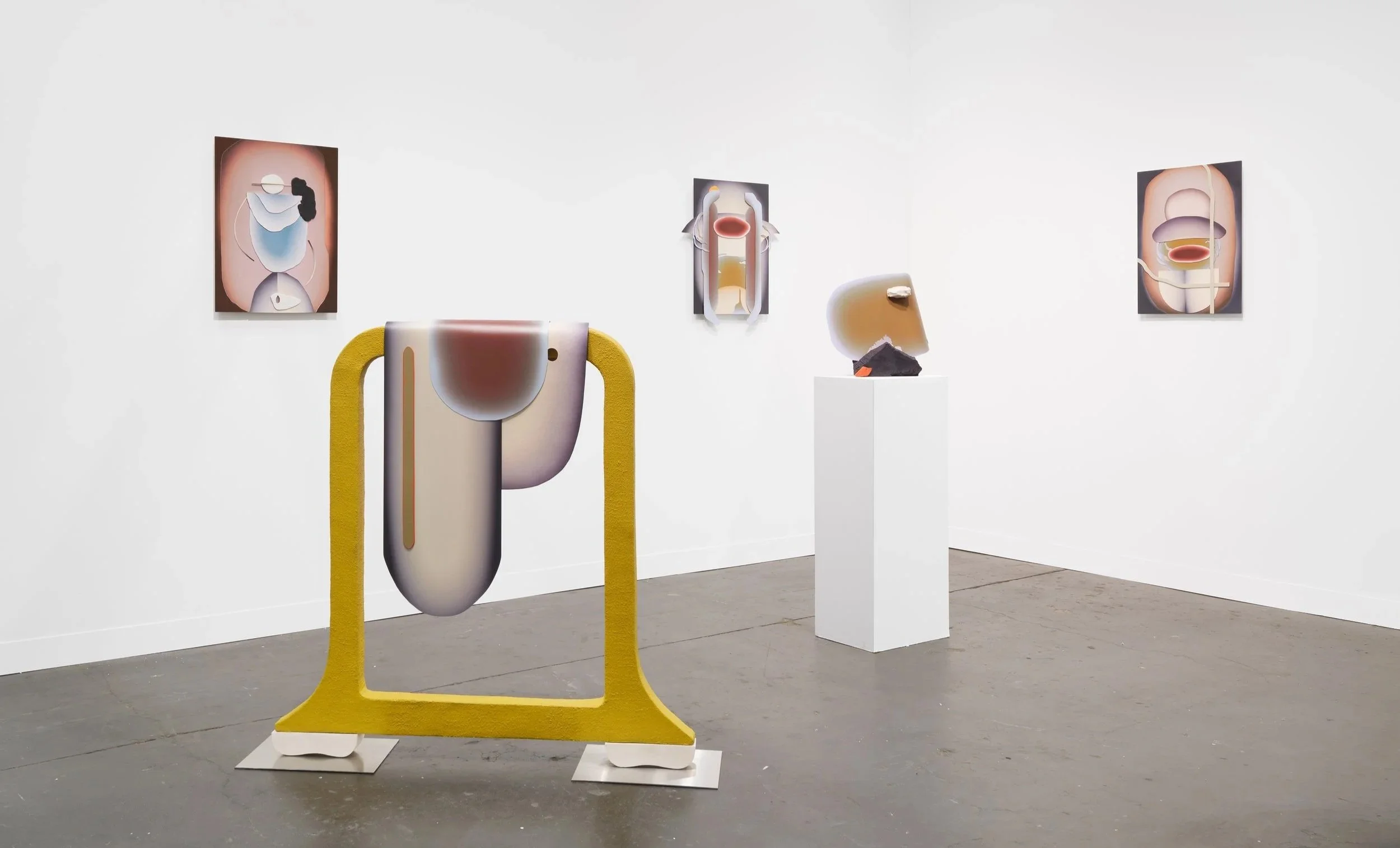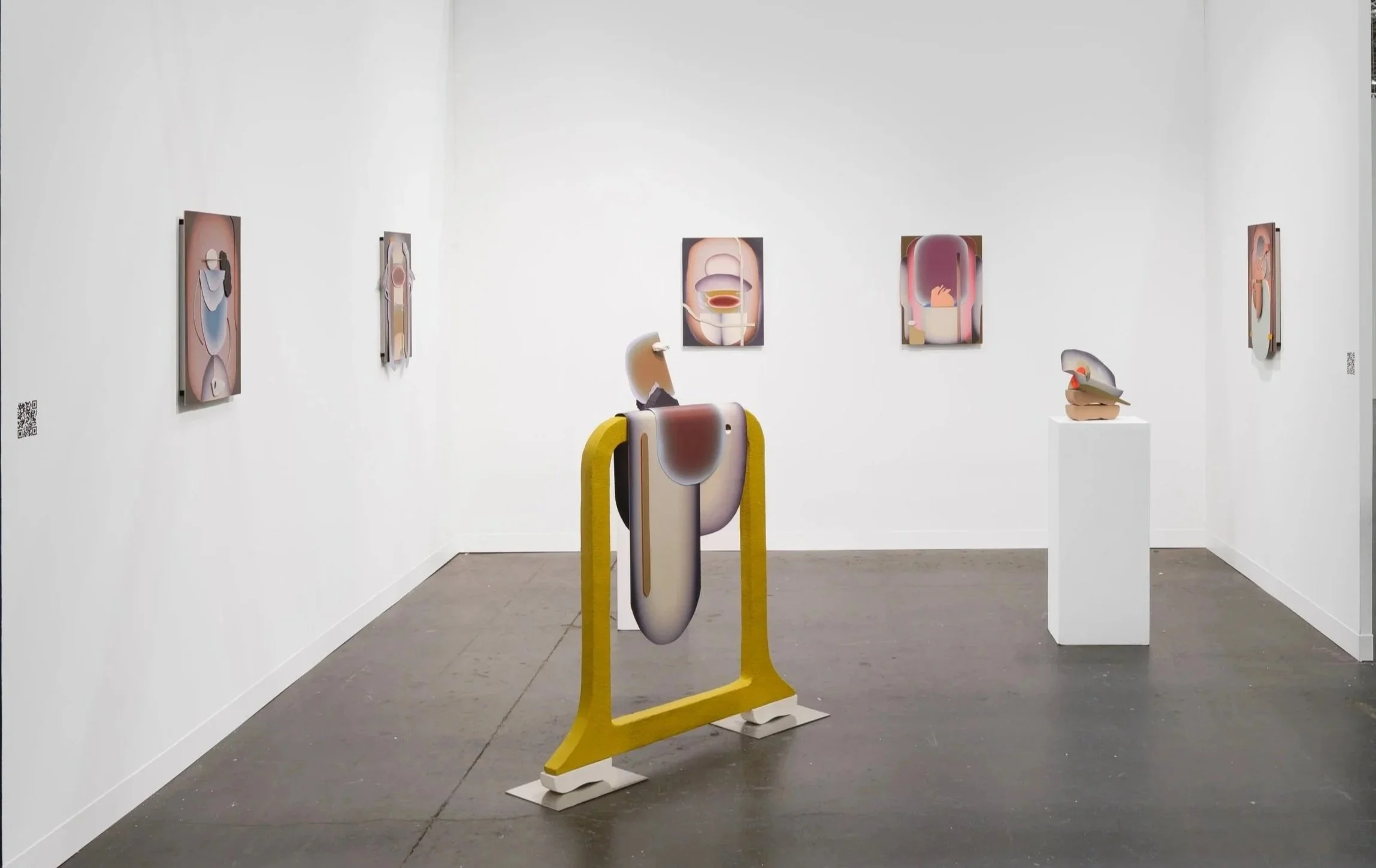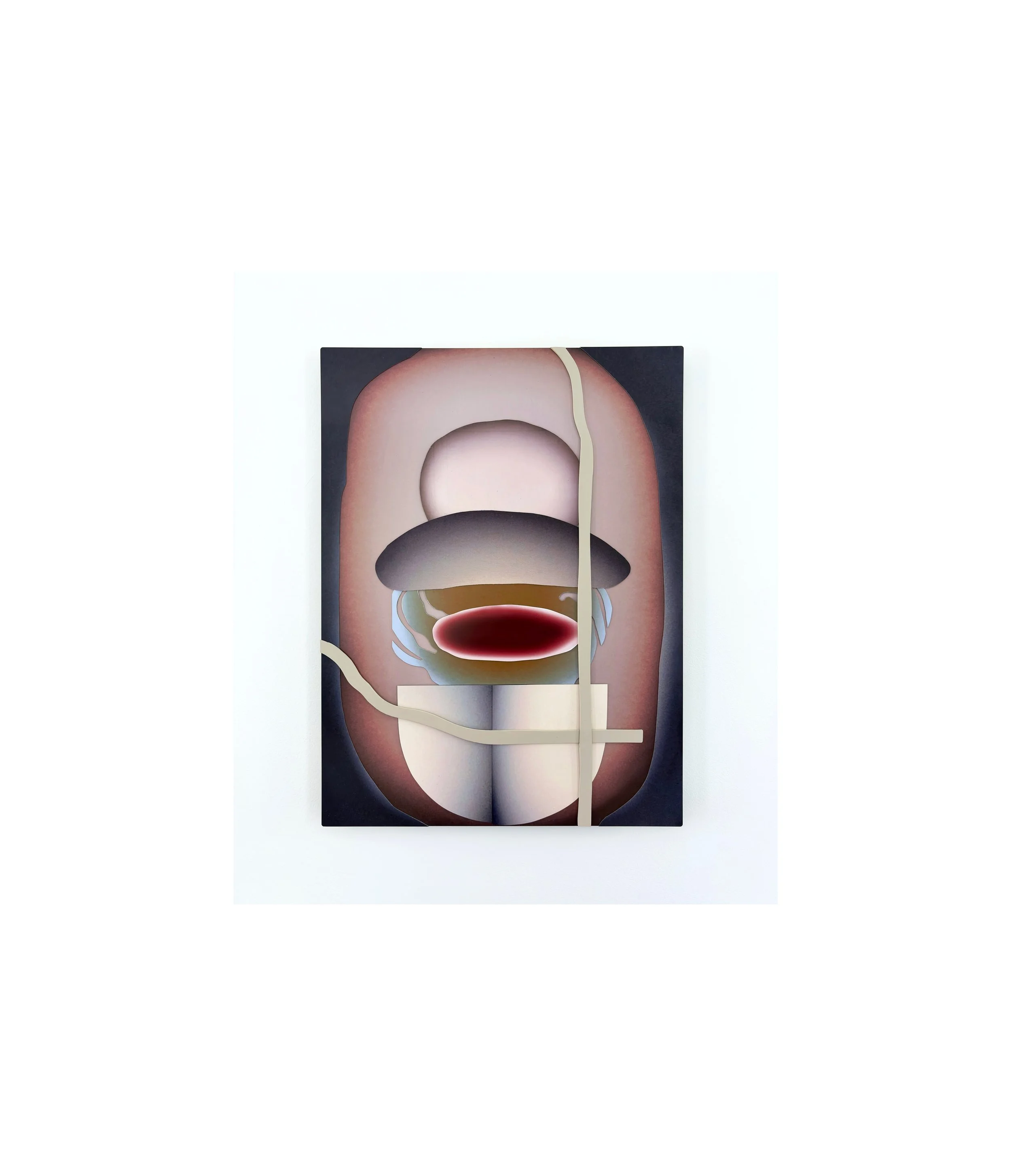
MaryKate Maher, Map 202, 2026, 24 x 18 x 2 in,
collaged dye sublimation prints on aluminum, faux leather, Dibond, acrylic paint
THE ARMORY SHOW 2026
MARYKATE MAHER
Booth P32
Opening Reception: September 24
September 24 - 27
KALINER is excited to present new body of collage and sculpture by MaryKate Maher. Working across two and three dimensions, Maher explores spaces that resist fixed definition, using abstraction to give physical form to what is fleeting, intangible, or only partially visible. Her works move between landscape, bodily forms, geological fragments, and atmospheric fields without settling into a single point of reference.
For this body of work, Maher draws inspiration from Inuit archaeological artifacts: small, hand-held sculptural maps once used to navigate the Arctic coastline and its islands. Carved wooden objects, often tooth-like in shape, these maps trace walking paths through grooves designed to be felt under the thumb as much as seen with the eye. Never entirely fixed, their paths respond to a landscape that is continually changing as ice melts, seas freeze, and the terrain shifts.
“How do you understand a space that is intangible yet visible?” asks MaryKate Maher. “As an artist I work to give that intangibility a form: tracing an outline, blurring a line, squinting at the shadow. Making it physical.”
Maher’s interest in navigation extends into her own process. She begins with her photographs of chromatic voids, translating these images across a range of materials, including aluminum, faux leather, and other surfaces. She cuts, bends, layers, and manipulates these photographic elements to construct collages and sculptural forms. As the photographs move between materials and dimensions, they become surfaces, fragments, and physical forms rather than remaining photographic representations. Gradients and tonal shifts suggest volume without fully defining it, while recurring ovals, semicircles, and irregular contours create forms that hover between recognition and abstraction. Landscape, geology, and the body emerge as points of reference, but remain deliberately unresolved.
The presentation continues Maher’s interest in the figure of the nomad or temporary inhabitant: one who moves through landscapes that are never entirely stable. Her abstraction is similarly intuitive, with each work developing through a process of following contours, responding to materials, and allowing unexpected forms to emerge. The works remain open-ended, asking the viewer to navigate them rather than simply observe them.
Maher’s recent works also reflect a sustained engagement with painting and its histories of abstraction. She is drawn to modernist painters such as Agnes Pelton, Paul Klee, and Georgia O’Keeffe, whose works connect expansive skies, desert landscapes, and the natural world with a sense of the celestial and spiritual. This lineage extends to artists such as Deborah Remington, whose use of the gradient turns tonal transition into an image in itself. In Maher’s work, gradients and fields of color similarly occupy an uncertain space between atmosphere and object, suggesting depth, light, and landscape without describing them directly.
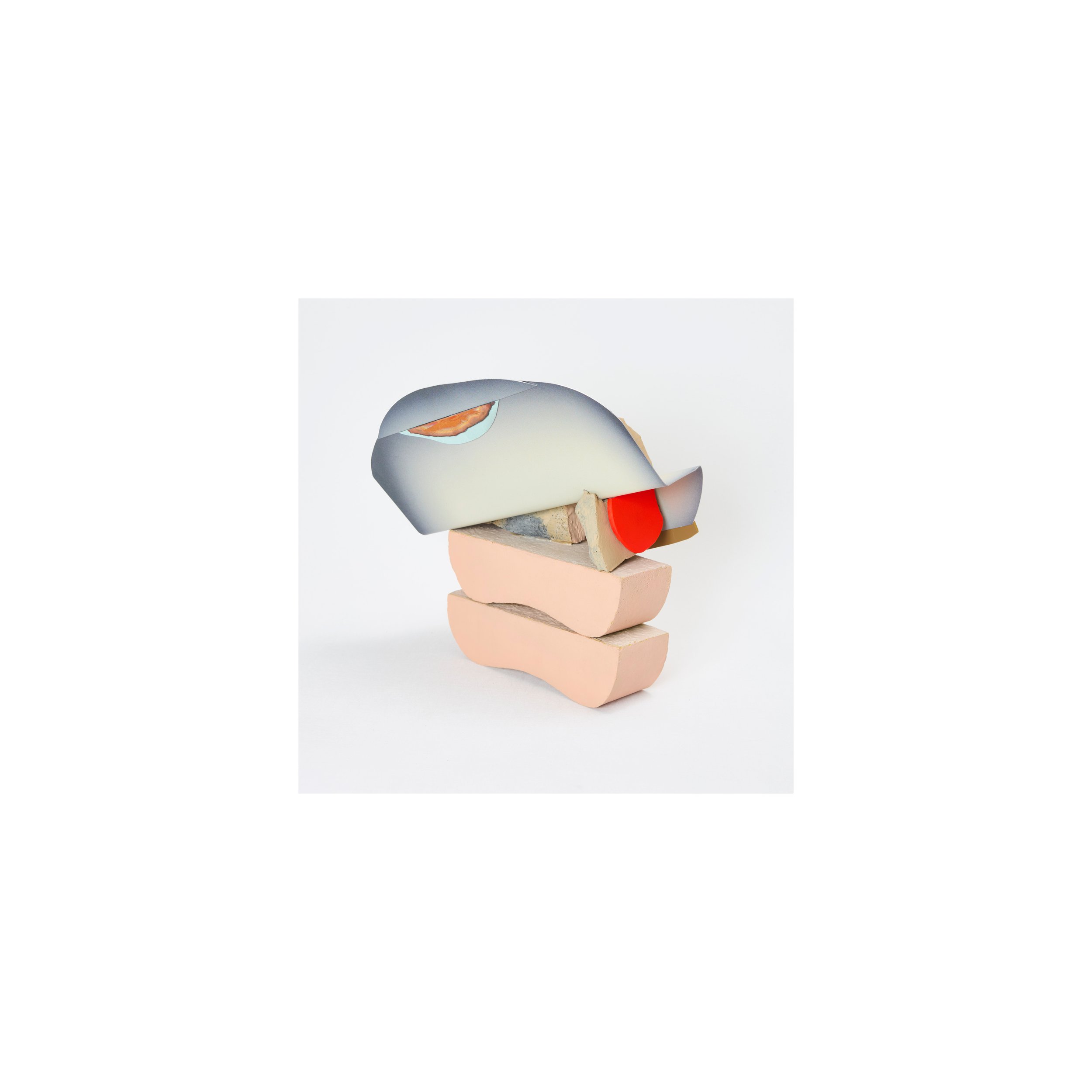
MaryKate Maher, Coordinate (orange), 2025, 11.5 x 13.5 x 6 in, aqua resin, aluminum, acrylic paint, hydrocal
In Coordinate (orange), a bent sheet of metal intersects with a protruding rock-like form, while surrounding elements appear to float between being anchored and adrift. Muted and fluorescent colors meet across smooth, irregular surfaces, while recurring ovals and semi-circles create tension between presence and suggestion. A teardrop-shaped form evokes an eye, introducing a moment of recognition and drawing attention back to the act of looking itself.
The two new sculptures continue the Coordinate series. In Coordinate (grey), a slightly curved oval print, reminiscent of a post-storm sky, slips into a chunk of rock with collaged elements affixed to its surface. The vaguely familiar shapes seem to turn toward the viewer, looking for an anchor. In Coordinate (ochre), a deconstructed landscape takes shape through draped and folded materials layered over a rounded frame, each layer suggesting another version of the sky. Together, the works ask: How many elements does a “landscape” need to be authentic?