
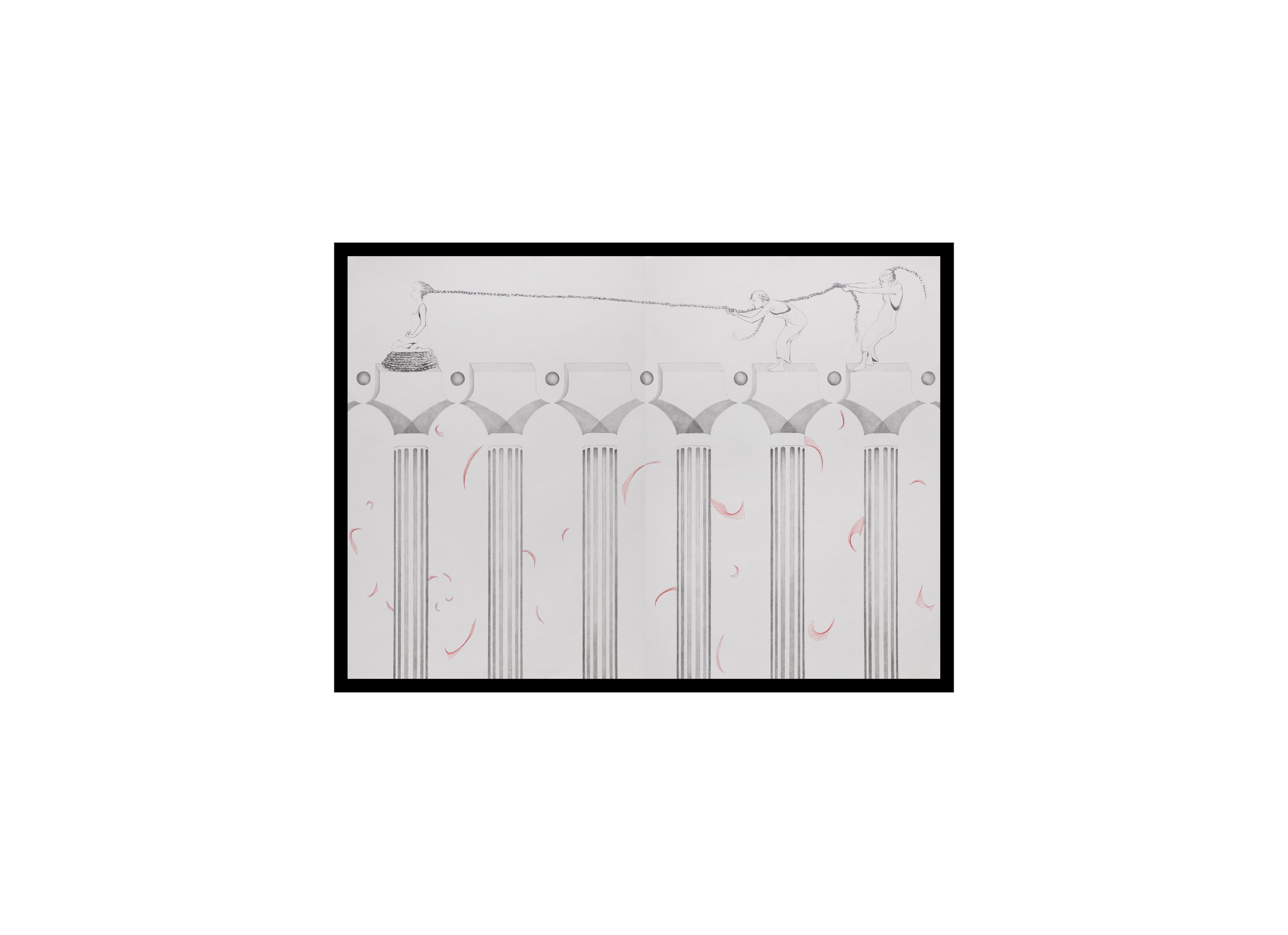
Dana Nechmad, Unwinding, Drawing and Embroidery on Paper, 27.56 x 78.74 in
Holding On To Nothing Is Not The Same As Letting Go
DANA NECHMAD
Opening Reception: November 12, 6:00 PM - 8:00 PM EST
November 11th – December 18th, 2026
KALINER is pleased to present Dana Nechmad’s inaugural solo exhibition with the gallery Holding On To Nothing Is Not The Same As Letting Go. The exhibition features drawings with embroidery on paper, textiles and a site specific drawing installation.
Dana Nechmad’s work explores how our identity, gender and power structures are shaped by the stories and images we inherit. Working across drawing, textile and embroidery, Nechmad combines personal experiences with references to art history, and western cultural traditions, creating scenes in which the familiar narratives begin to unravel.
In this body of work, Nechmad returns to fragments of ancient Greek and Roman sculpture’symbols of authority. Rather than reconstructing these histories as coherent stories, she reimagines them through unexpected encounters and shifting relationships. Her figures inhabit a world where the past and present overlap, and where the boundaries between the personal and the historical remain uncertain.
As Maya Bamberger wrote in her essay about the exhibition (below), women have long appeared in art as representations of abstract ideals, from justice to liberty, while their lived experiences have often remained secondary. Nechmad places her women at the center of her compositions, giving them agency within scenes shaped by desire, struggle and force. They occupy an active role in the composition as they challenge these ideals and invite contradictory positions: vulnerable yet defiant, connected yet constrained, capable of both supporting and burdening one another.
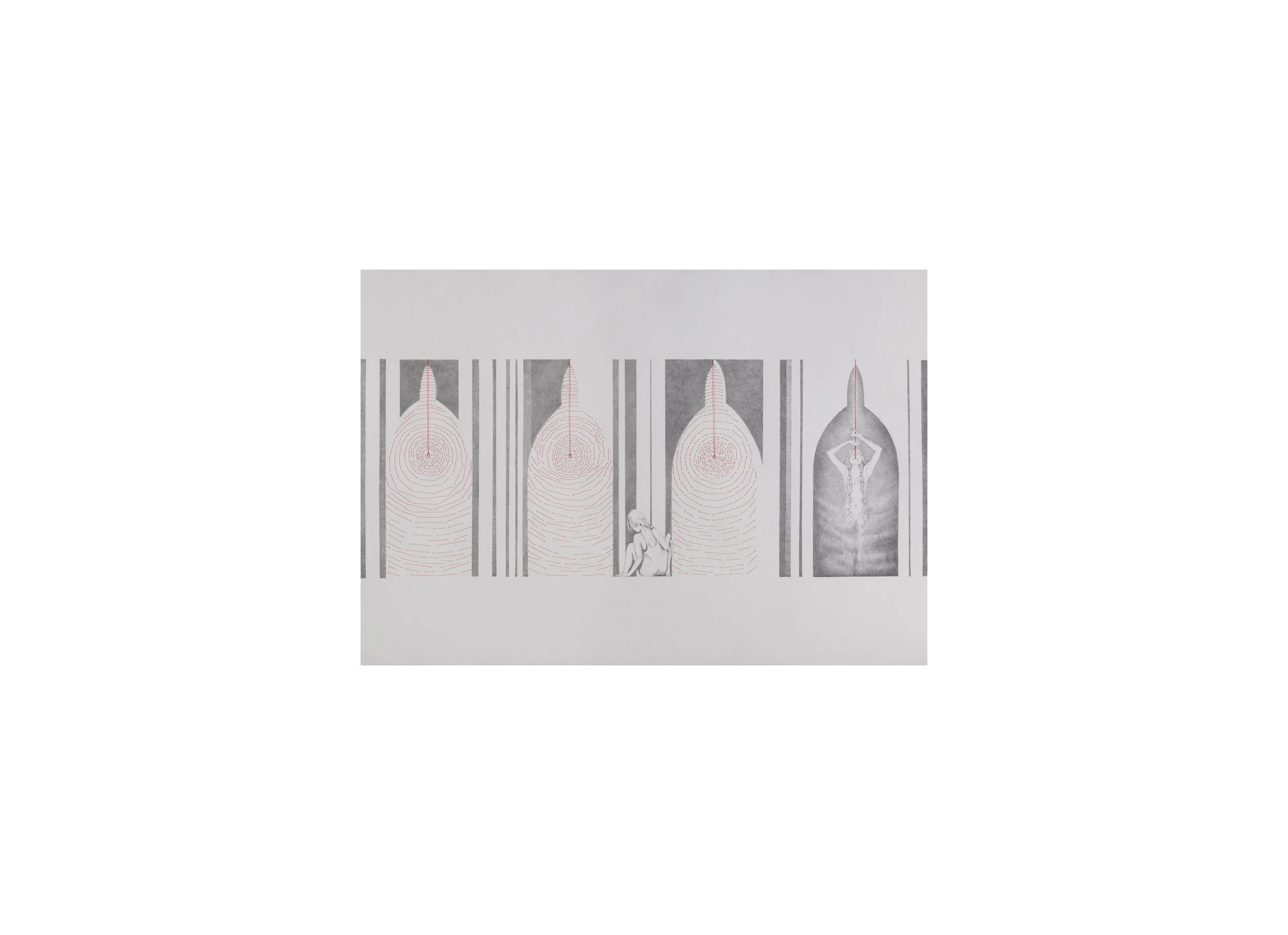
Dana Nechmad, Fireflies, Drawing and Embroidery on Paper, 27.56 x 39.37 in
The arch recurs throughout Dana Nechmad’s exhibition: painted on the wall, embroidered on paper, and formed by drawn figures supporting one another. It recalls the order and authority of monumental architecture while marking a threshold between past and present, myth and lived experience. Within her personal mythology, this inherited form becomes less certain: fragmented bodies unsettle its apparent permanence, while holes pierced through paper give absence a physical presence, echoing the traces left by a memory or an idea that no longer holds. Where women sustain the structure, each figure supports the whole while remaining bound to her position within it. The opening promises passage, yet the arch depends on their staying in place.
Hair, so closely tied to a woman’s identity and charged with associations of passion and desire, takes on another role in Nechmad’s work. Braided, it becomes a rope or a tool extending from the body, connecting women or drawing them into entanglement. Nechmad plays with this symbolism: the strands remain visible, yet are concealed within the tightly woven form. Both a physical extension and almost a character in its own right, the braid unsettles the boundary between what belongs to her and what acts independently, deepening the imagery’s enigmatic quality.
The canvas Nechmad uses in her work is submerged in deep dye for an extended period, then stretched across the floor. Working quickly with bleach, the artist reveals larger-than-life figures from within the fabric itself—a form of removal that paradoxically creates a positive presence, like a double negative.
In Holding on to Nothing Is Not the Same as Letting Go, tensions unfold through figures and objects caught between opposing forces. The title suggests that attachment and release are not simple opposites. What sustains us can also weigh us down; what we struggle to leave behind may remain part of who we are. Nechmad’s figures navigate these contradictions without arriving at easy resolutions, reflecting the complicated ways personal experience becomes entangled with inherited expectations, memory, and the structures of power that shape our lives.