
Arte Ref
Brazilian Artist Pàulla Scávazzini debuts in New York and Rio de Janeiro with new paintings and site-specific installations.
April 29, 2026
Brazilian visual artist Pàulla Scávazzini presents two new exhibitions that mark a decisive moment in her career: participation in the duo show "Between Utopias and Abyss," curated by Maryana Kaliner, at the Kaliner Gallery in New York, and the solo exhibition Língua de Fogo (Tongue of Fire), curated by Shannon Botelho, at the Centro Cultural Correios in Rio de Janeiro.
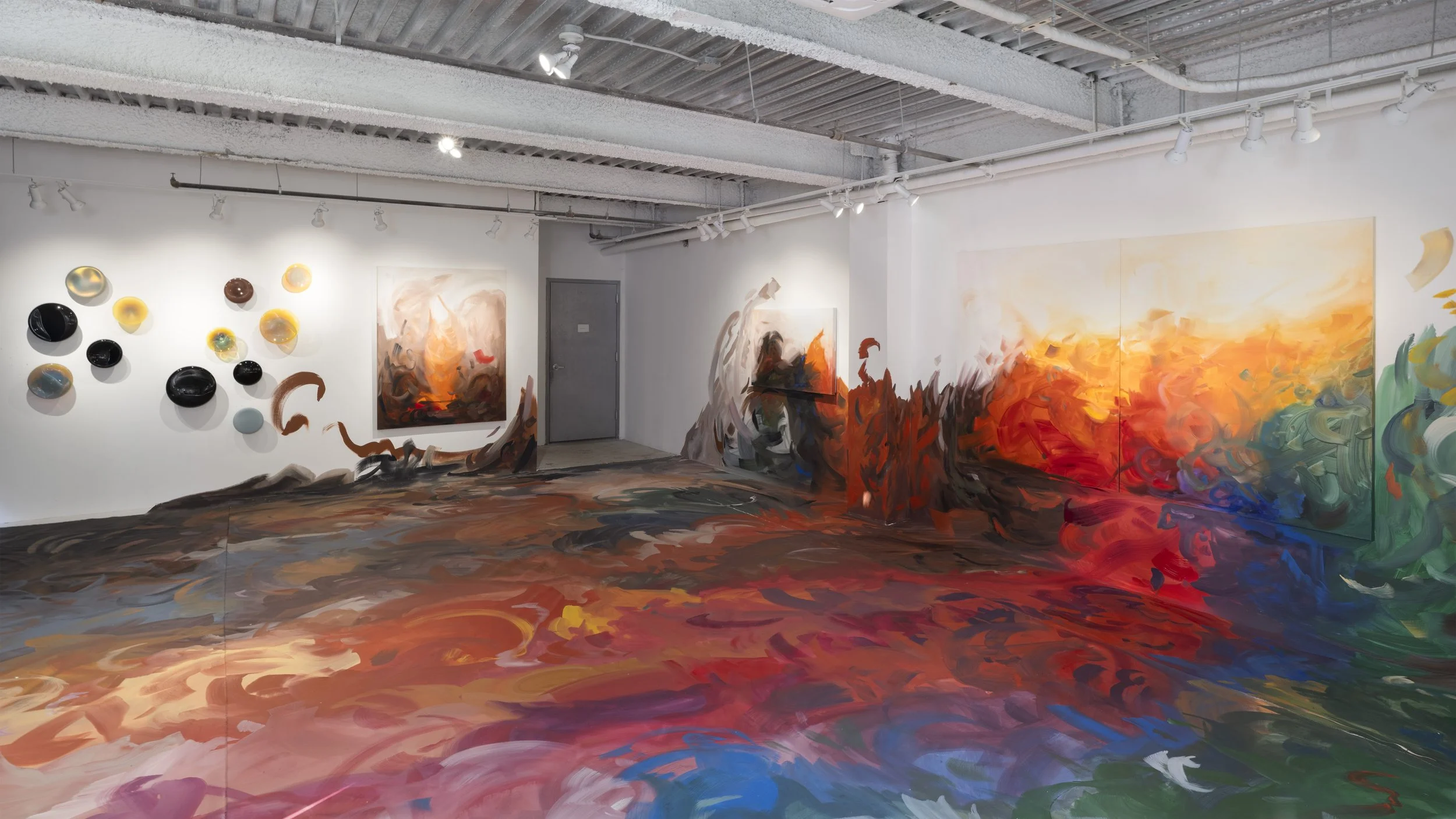
Scàvazzini develops research that challenges the boundaries between architecture, body, and painting, shifting the gesture from the two-dimensional plane to immersive experiences where paint advances across walls and floors, in installations and site-specific works. In this context, the artist proposes to question how the viewer's bodily perception can be modified through this sensory and affective experience. Her works, marked by strong gestural expression and an in-depth study of color, light, and composition, draw from tropical botanical imagery to construct atmospheres that oscillate between landscape and ruin, articulating environmental and social collapse with the idea of reinvention. The sensory dimension also extends to the titles of the works, conceived as synesthetic micro-poems—desert wind; salt bonfire; precipice, sigh; everything that shines in the north and melts in celebration in the south—that evoke smell, temperature, and memory in parallel with the encounter of the gaze with the image.
In this context, the two exhibitions share central axes of their investigation: painting as gesture and performance; the exploration of scale – from the intimate to the architectural –; the transformation of the viewer's spatial and sensory perception; and the construction of intense chromatic fields, which simultaneously propose destruction and regeneration. Starting from fragments of vegetation and organic elements, their works transform into stains, fields of color, and atmospheres that challenge the relationship between figuration and abstraction, reflecting the complexities of a contemporary world in constant metamorphosis.
The artist comments: "Both exhibitions stem from the tropical botanical imaginary, in which landscapes dissolve into patches and fields of color. This dissolution of the image is also a refusal to offer the landscape of a collapsing world as consolation, as if art could restore ruins. What interests me is a painting that remains in this tension, and which, for that very reason, needs to leave the canvas to encounter the body. It is this painting that, starting from my moving body, advances onto the architectural space and summons an encounter with the other bodies that enter the room."
About the exhibition in New York
In her participation in the exhibition opening on April 23rd in New York, alongside artist Austin Fields (1988, Los Angeles), Scàvazzini presents a new collection of works developed during her residency at Residency Unlimited, one of the most important art institutions in the United States. The exhibition brings together 20 works and is organized as a large and visceral expanded painting, occupying walls, floors, and canvases at different scales and establishing a direct relationship with the viewer, the street, and the city.
Curated by Maryana Kaliner, the works propose a reflection on "utopias" in the plural, understood as states in permanent transformation, caught between promise and collapse. In this context, manual gesture and making emerge as forms of resistance and affirmation, especially in the production of women artists who work from matter and the body.
“For this exhibition, I will be experimenting to the fullest with my research into scale, stretching the painting from the smallest format to large dimensions, painting an entire gallery, open to the public, something I almost never encounter – and even less so in a gallery in NY with a large glass facade facing the city,” says Scàvazzini.
In the international exhibition, his paintings engage in direct dialogue with Austin Fields' glass sculptures, creating a relationship in which the canvases function as expanding landscapes, while the sculptures appear as fragments of those same landscapes, encapsulated and condensed into three-dimensional form. The ensemble functions as a single organism, in which each work acts as a fragment of a larger composition.
“I understand the act of painting as a whole-body practice—almost a pictorial psychography, in the sense that it is not the hand that decides the image, but the body that guides it while the mind withdraws. Each brushstroke records a time of execution that is physical before it is intellectual. It is cathartic. In the New York exhibition, this manifests itself in large-scale canvases, in works created directly on architecture, and in smaller-format paintings that present themselves as windows or fragments of a larger whole—an invitation to memory, observation, and other perspectives in relation to the surrounding space,” explains Paula Scávazzini.
Regarding the exhibition in Rio de Janeiro
In Rio de Janeiro, opening on May 27th, Pàulla presents an exhibition of fifteen works that serves as an extension of the show held in New York, now guided by the more rigid limits and expanded spatiality of an institutional context. With most of the works being new, the artist deepens her research on gesture, on the transformation of the viewer's perception and being in relation to the work, revisiting the study of color and contemporary apocalyptic landscapes.
About the artist Pàulla Scàvazzini
Paula Scávazzini (1990, São José dos Campos, Brazil) is a visual artist based in São Paulo. Her practice focuses on painting as an expanded language, exploring multiple media and scales, from small formats to architectural dimensions. With a background in Visual Arts, Art Education, and Architecture and Urbanism, her work articulates color, space, and gesture in investigations that engage with themes such as ecology, contemporary collapse, and imaginaries of reconstruction.
The artist has participated in residencies at institutions such as Cité Internationale des Arts (Paris), Zaratan (Lisbon), and the School of Visual Arts (New York), and has presented exhibitions in spaces such as Paço das Artes, Casa Triângulo, and SVA. Her work is part of public collections, such as the Museu de Arte Brasileira (MAB-FAAP) and the Museu Inimá de Paula, as well as private collections in Brazil and abroad.